If you are evaluating packaging substrates for a new SKU or reconsidering an existing one, the choice between PET, PP, and paper comes down to four factors: product visibility requirements, structural demands, retail environment, and sustainability commitments.
This guide is written for procurement managers and packaging development teams who already understand the basics and need a practical framework to make the right substrate decision — and brief their vendor correctly.
The Three Substrates at a Glance
Before getting into the decision framework, here is a clear baseline for each material.
PET (Polyethylene Terephthalate) is a rigid, fully transparent plastic substrate. It offers the highest optical clarity of the three options, making the product inside completely visible. It is dimensionally stable, resistant to moisture, and holds print well when offset printing is applied directly to the substrate. rPET (recycled PET) is now available as a sustainable alternative with comparable performance to virgin PET.
PP (Polypropylene) is available in two distinct forms relevant to packaging: transparent or frosted PP monocartons, and PP corrugated cartons. Transparent PP monocartons offer a semi-clear to frosted presentation and are widely used in personal care and cosmetics. PP corrugated cartons — a twin-wall fluted PP sheet formed into a box — offer significantly higher structural strength and are used where durability and reusability matter more than aesthetics.
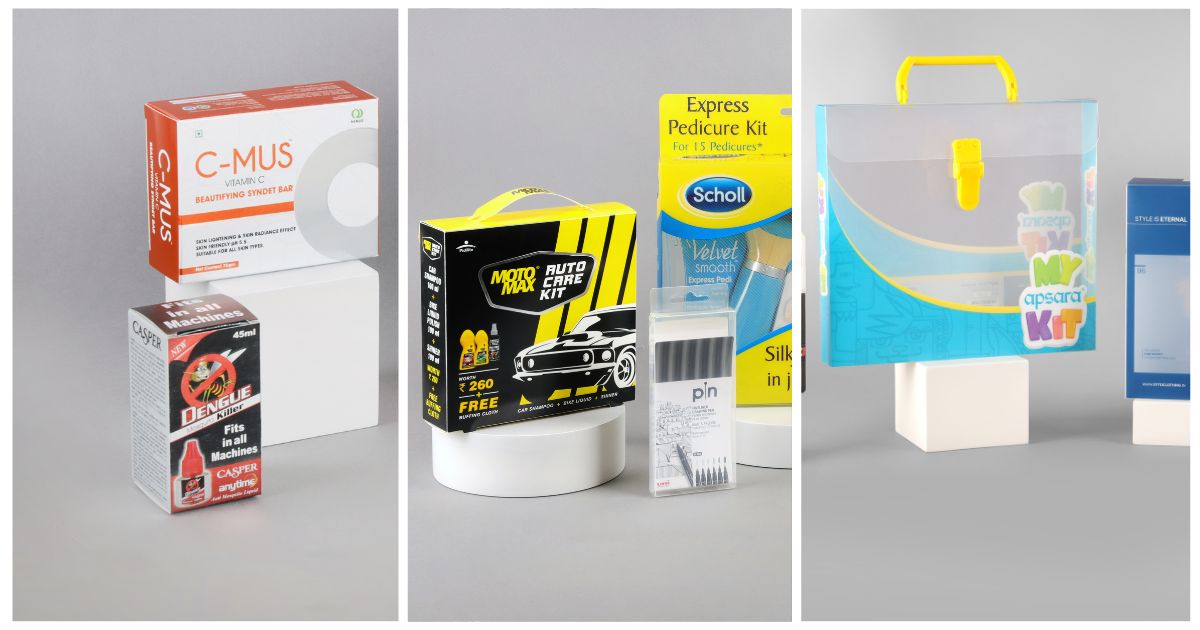
Paper and paperboard monocartons remain the most widely used primary and secondary packaging format across industries. They accept the widest range of printing and finishing effects, are the most cost-effective at scale, and offer the strongest sustainability story — particularly when manufactured from FSC-certified or recycled board. Window patching (using PP or PET film) can be applied to paper monocartons to create partial product visibility without switching to a full plastic substrate.
When to Choose PET Packaging
Choose PET when product visibility is the primary driver of the packaging decision.
PET is the right substrate when the product itself — its colour, texture, shape, or form — is a selling point on the retail shelf. A skincare serum in a premium glass bottle, a lipstick in a distinctive bullet form, a perfume in an unusual shape — these products sell partly because the buyer can see exactly what they are getting. PET packaging enables this without compromising on branding, because modern offset printing on PET allows full multicolour graphics directly on the substrate.
Industries and applications where PET packaging performs best:
Cosmetics and personal care brands use PET extensively for lipstick cartons, mascara boxes, serum secondary packaging, compact cases, and perfume boxes. The transparency communicates premium quality and lets the product speak before the consumer reads a single line of copy.
FMCG combo packs and gift sets use PET when the objective is to show multiple products together — a shampoo and conditioner duo, a personal care bundle — in a single retail-ready pack. The consumer sees what they are buying, which reduces purchase hesitation.
Stationery and accessories packaging uses PET for products like pens, markers, and small tools where the product range or colour variety is itself the differentiator.
When rPET is the right choice within this category:
If your brand has sustainability commitments — or if your retail partner (a large-format modern trade or e-commerce platform) has supplier sustainability requirements — rPET offers the same optical clarity and print performance as virgin PET with a significantly lower carbon footprint. rPET is increasingly being specified by FMCG brands with ESG reporting requirements and by export-focused brands supplying European retail.
What to check before specifying PET: MOQ on PET runs higher than paper due to substrate cost. Confirm your volume requirement before specifying PET. Artwork for PET printing requires specific pre-press preparation — supply print-ready files and confirm colour profiles with your manufacturer before plate-making.
When to Choose PP Packaging
PP packaging divides into two distinct use cases and it is important not to conflate them.
Transparent PP Monocartons
Choose transparent PP monocartons when you want the soft visibility and tactile quality of a frosted or semi-clear box — a look that reads as premium without the full optical transparency of PET. This finish is common in cosmetics (beauty tools, makeup accessories, skincare kits) and in personal care gift packaging where the frosted effect adds a deliberate aesthetic quality.
PP monocartons also accept direct offset printing, so branding and product information can be printed on the substrate itself. Hot stamping and UV coatings can be applied for additional finish effects.
Compared to PET, PP monocartons are slightly more flexible and have a softer feel — a consideration for products where the unboxing tactility matters to the end consumer.
PP Corrugated Cartons
Choose PP corrugated cartons when structural performance and durability are the primary requirements — not aesthetics.
PP corrugated is a twin-wall fluted polypropylene sheet. It is significantly stronger than paperboard, moisture-resistant, and reusable. This makes it the preferred substrate for industrial secondary packaging, transit packaging for fragile products, reusable inner packaging for garment and textile shipments, and any application where the packaging will be handled repeatedly or stored in variable conditions.
Industries and applications where PP corrugated performs best:
Garments and apparel manufacturers use PP corrugated for inner transit boxes and shelf-ready display trays that need to survive multiple handling cycles between factory and retail floor. Unlike paperboard, PP corrugated does not collapse under moisture or repeated use.
Electronics and hardware brands use PP corrugated for protective inner packaging where impact resistance matters. The material absorbs handling stress better than paperboard at equivalent thickness.
Home textiles and heavy consumer goods use PP corrugated where the packaging needs to carry weight without deforming — bed linen sets, towel packs, and similar products where a paperboard box would show wear quickly.
The key distinction to brief your vendor on: PP corrugated and PP monocarton are different products made on different machinery. Confirm with your manufacturer which form of PP you are specifying before requesting a quote. Mixing these up at the brief stage leads to incorrect quotes and delays.
When to Choose Paper Packaging
Choose paper monocartons when you need the broadest print and finish flexibility, the most cost-effective substrate at scale, or the strongest sustainability narrative.
Paper remains the default substrate across most packaging categories for good reason. It accepts offset, screen, and digital printing. It supports the full range of finishing — hot stamping, embossing, debossing, matte UV, gloss UV, spot UV, lamination. It can be produced from FSC-certified or recycled board. And at commercial volumes, it is the most cost-efficient substrate of the three.
Industries and applications where paper monocartons perform best:
Pharmaceuticals use paper monocartons as primary and secondary packaging for tablets, capsules, creams, and drops. Regulatory print requirements — ingredient lists, batch numbers, expiry dates, barcode placement — are easier to achieve and more legible on paper than on plastic substrates.
FMCG brands across food, personal care, and household products use paper monocartons for the vast majority of their SKUs. The combination of high-volume production efficiency, wide finishing options, and sustainability credentials makes paper the default choice.
Cosmetics and beauty brands use paper monocartons for products where the packaging is fully enclosed — eyeshadow palettes, foundation boxes, haircare product packaging — and product visibility is not required.
Garments and apparel brands use printed paper boxes for retail-ready packaging of folded garments, accessories, and gift sets where the box itself communicates brand quality.
Window patching — the hybrid option:
If your brief requires a paper monocarton but a specific panel needs product visibility, window patching is the solution. A die-cut window in the paperboard is patched with a PP or PET film, allowing a controlled view of the product while the rest of the box remains paper. This is widely used in personal care, stationery, and food packaging and combines the sustainability and print advantages of paper with partial transparency.
Sustainability considerations for paper:
Paper packaging manufactured from FSC-certified board or recycled content offers the strongest sustainability positioning of the three substrates. For brands with sustainability reporting requirements or modern trade partners with packaging compliance mandates, paper with certified board is typically the easiest specification to defend. Combine this with water-based coatings rather than solvent-based lamination and the sustainability case becomes significantly stronger.
Side-by-Side Decision Framework
Use this framework when evaluating which substrate to specify for a new SKU.
Product visibility required? Full visibility → PET Partial or frosted visibility → Transparent PP monocarton No visibility required → Paper monocarton
Primary function of the packaging? Retail shelf presentation → PET or Paper monocarton Premium tactile unboxing → Transparent PP monocarton Transit and structural protection → PP corrugated
Volume and cost sensitivity? Highest cost efficiency at scale → Paper Mid-range → PP monocarton Higher cost, premium application → PET / rPET
Sustainability requirement? Strongest narrative → Paper (FSC-certified or recycled board) Circular economy / recycled content → rPET Durability and reuse → PP corrugated
Finishing complexity? Maximum options → Paper Good options with premium feel → PP monocarton Clean and minimal, product-forward → PET
Common Mistakes When Choosing a Substrate
Specifying PET for structural applications. PET monocartons are designed for retail presentation, not for transit or repeated handling. If your packaging needs to survive a supply chain, evaluate PP corrugated or a heavier paperboard grade instead.
Assuming paper is always the sustainable choice. Paper with solvent-based lamination or non-certified board is not necessarily more sustainable than rPET or reusable PP corrugated. Evaluate the full material specification, not just the substrate category.
Overlooking MOQ differences between substrates. PET and PP runs typically have higher MOQs than paper due to substrate cost and setup requirements. If your volume is at the lower end of commercial scale, paper monocartons are the more practical starting point.
Requesting a quote without specifying the substrate. Procurement teams that send a brief without a substrate preference receive a quote range, not a firm number. The difference in unit cost between paper, PP, and PET for the same box dimensions can be significant. Specify your substrate preference — even provisionally — for an accurate quote.
Frequently Asked Questions
What is the difference between PET and PP packaging? PET offers full optical transparency and is used where the product needs to be completely visible through the box. PP is available as a semi-transparent or frosted monocarton for a softer premium aesthetic, or as a corrugated structural material for durability and transit use. Both can be printed directly with offset printing.
Is rPET packaging available in India? Yes. Globe Print n Pack manufactures packaging using rPET (recycled PET) substrate. rPET offers comparable clarity and print performance to virgin PET and is appropriate for brands with sustainability commitments or ESG reporting requirements.
Can I get a paper box with a transparent window? Yes. Window patching is a standard process where a PP or PET film is applied over a die-cut window in a paper monocarton. This gives you the sustainability and print advantages of paper with partial product visibility on one or more panels.
Which substrate is best for cosmetics packaging? It depends on the product. For lipstick, mascara, serums, and products where visibility drives purchase — PET or transparent PP monocartons. For eyeshadow, foundation, haircare, and products in fully enclosed packaging — paper monocartons with premium finishing. Many cosmetics brands use all three substrates across their SKU range.
What is the MOQ for PET, PP, and paper packaging at Globe Print n Pack? Standard MOQ is 15,000 units per SKU across substrates. Brands or OEM manufacturers with requirements below this volume are advised to plan for scale before initiating a production order.
Working With Globe Print n Pack
Globe Print n Pack manufactures PP monocartons, PP corrugated cartons, PET and rPET boxes, and paper monocartons — all with in-house printing and finishing at our Vasai, Mumbai facility. We supply to procurement teams at established brands and to OEM manufacturers working on behalf of brands.
If you are evaluating substrates for a new or existing SKU, share your brief with our team. We will confirm which substrate and specification fits your product, volume, and retail requirement — and provide a quote based on your actual dimensions and order quantity.
Request a quote → View our cosmetic packaging → Explore our PET packaging → See our PP cartons
Globe Print n Pack Industries Pvt. Ltd. | Vasai, Mumbai | ISO 9001:2015 | SEDEX Certified | NAEP 2024 Award — Best PET Mono Carton