
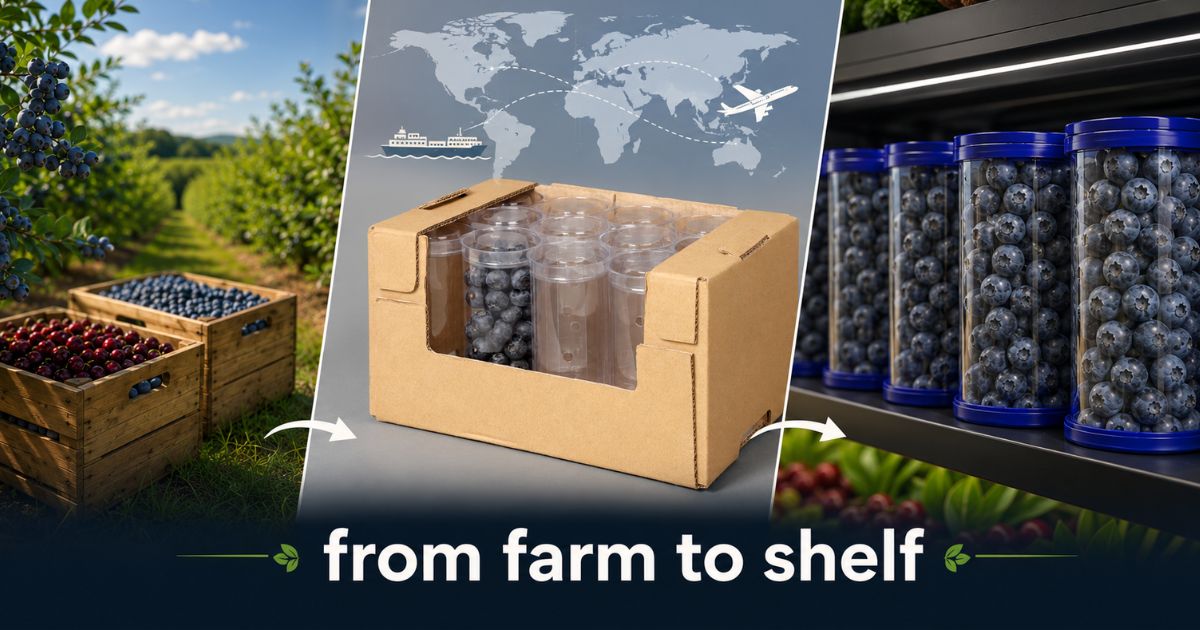
Global fresh produce exports have witnessed significant growth over the past decade as consumers seek year-round access to premium fruits and vegetables sourced from different regions of the world. Countries such as India, Spain, Peru, Chile, South Africa, and Morocco continue to expand their presence in international markets, supplying fresh produce to destinations including the UAE, Netherlands, Germany, United Kingdom, France, and Saudi Arabia.
As international trade increases, exporters are discovering that product quality alone is no longer enough. Packaging has become a critical factor influencing product protection, shelf life, retail acceptance, brand visibility, and ultimately consumer purchasing decisions.
From the moment fruit is harvested until it reaches a supermarket shelf thousands of kilometres away, packaging plays a vital role in maintaining freshness and creating value throughout the supply chain.
The Growing Importance of Fresh Produce Packaging
Fresh produce is among the most delicate product categories in global trade.
Unlike processed goods, fruits and vegetables remain highly vulnerable to:
- Bruising
- Compression damage
- Moisture loss
- Temperature fluctuations
- Contamination
- Handling stress
For exporters shipping blueberries, cherries, grapes, strawberries, citrus fruits, and specialty produce, packaging must perform multiple functions simultaneously.
Packaging must:
- Protect the product
- Support cold chain logistics
- Maintain freshness
- Enhance shelf appeal
- Communicate brand identity
- Meet retailer requirements
As a result, fresh produce packaging has evolved from a transportation necessity into a strategic business asset.
Stage 1: Harvesting and Post-Harvest Handling
The packaging journey begins immediately after harvest.
Fresh produce can lose value rapidly if not protected during initial handling and sorting operations.
At this stage, packaging must help:
- Reduce product movement
- Minimise bruising
- Facilitate efficient handling
- Maintain airflow around the product
For premium fruit categories such as blueberries and cherries, even minor damage can impact retail acceptance and reduce export value.
Proper packaging begins with understanding how the product behaves during harvesting, grading, and packing operations.
Stage 2: Cold Storage and Supply Chain Management
Fresh produce exports depend heavily on cold chain infrastructure.
Packaging must work alongside refrigeration systems to preserve product quality during storage and transportation.
Exporters increasingly require packaging that provides:
Ventilation
Airflow helps maintain freshness and supports temperature management.
Structural Integrity
Packaging must withstand stacking and transportation loads.
Moisture Management
Excess moisture can negatively affect fruit quality and shelf life.
Logistics Efficiency
Packaging dimensions influence pallet utilisation, transportation costs, and warehouse efficiency.
Packaging that performs well within cold chain environments contributes directly to product quality and export success.
Stage 3: International Transportation
Fresh produce often travels across multiple countries before reaching consumers.
Indian fruit and vegetables exporters regularly ship fresh produce to markets including:
- United Arab Emirates (UAE)
- Saudi Arabia
- Netherlands
- Germany
- United Kingdom
- France
- Spain
These export journeys may involve road transport, air freight, sea freight, and multiple handling points.
Packaging must therefore withstand:
- Long transit times
- Container loading pressures
- Repeated handling
- Vibration during transportation
- Variable environmental conditions
Export-ready packaging is designed not only for protection but also for consistency throughout the supply chain.
Stage 4: Retail Shelf Presentation
Once products reach retailers, packaging takes on an entirely different role.
Protection remains important, but presentation becomes equally critical.
Modern retailers expect packaging to provide:
- Product visibility
- Easy merchandising
- Brand communication
- Consumer convenience
- Premium shelf presentation
Retail chains across Europe and the Middle East increasingly evaluate packaging quality as part of supplier selection.
Exporters that invest in retail-ready packaging often gain a competitive advantage by improving consumer perception and enhancing shelf impact.
Why Retail-Ready Packaging Is Becoming Essential
Consumer purchasing decisions are often influenced within seconds.
When shoppers compare multiple products on a shelf, packaging becomes a silent salesperson.
Retail-ready packaging helps exporters:
- Increase product visibility
- Differentiate products from competitors
- Strengthen brand recognition
- Communicate origin and quality
- Improve overall shopping experience
For premium fruit categories, packaging can significantly influence perceived product value.
The Evolution Beyond Traditional Packaging
Corrugated cartons continue to serve as the primary transport packaging solution for fresh produce exports.
However, secondary packaging formats are evolving rapidly.
Today, exporters use a combination of:
- Corrugated cartons
- Punnets
- Clamshells
- Trays
- Flow-wrap solutions
- Retail-ready packaging
- Thermoformed packaging formats
Each packaging format serves a specific purpose within the supply chain.
The growing focus on retail presentation is encouraging exporters to explore packaging solutions that provide both protection and visual appeal.
The Rise of Thermoformed Packaging Tubes
One packaging innovation attracting attention among fresh produce exporters is the thermoformed packaging tube.
Developed to combine product visibility, protection, and branding, thermoformed tubes provide a modern alternative for premium fruit categories.
A typical thermoformed tube consists of:
- Thermoformed bottom cup
- Thermoformed top cap
- Custom printed sleeve
This structure creates a distinctive packaging format that protects the product while allowing consumers to view the contents clearly.
Why Thermoformed Tubes Are Gaining Interest
Enhanced Product Visibility
Consumers can inspect the fruit before purchasing, increasing confidence in product quality.
Premium Shelf Appeal
The cylindrical structure immediately differentiates products from conventional packaging formats.
Stronger Branding Opportunities
Custom printed sleeves provide space for:
- Brand logos
- Product information
- Certifications
- Country of origin
- QR codes
- Sustainability messaging
Product Protection
The rigid structure helps reduce compression damage during handling and transportation.
Retail Differentiation
Premium fruit categories such as blueberries, cherries, grapes, and specialty berries benefit from unique retail presentation.
Thermoformed RPET Packaging for Fresh Produce
As sustainability becomes increasingly important, exporters are evaluating materials that balance performance and environmental responsibility.
Thermoformed packaging tubes can be manufactured using:
RPET (Recycled PET)
Offers:
- Recycled content
- Reduced environmental impact
- Similar performance characteristics
- Support for sustainability initiatives
These materials help exporters align packaging decisions with retailer expectations and sustainability objectives.
Packaging Innovation as a Competitive Advantage
Global fresh produce markets continue to become more competitive.
Exporters are no longer competing solely on:
- Product quality
- Price
- Availability
They are also competing on:
- Presentation
- Brand recognition
- Consumer experience
- Retail acceptance
Packaging innovation therefore becomes an important differentiator.
Solutions such as thermoformed packaging tubes demonstrate how packaging can contribute to both product protection and commercial success.
The Future of Fresh Produce Export Packaging
Retailers, consumers, and export markets are placing greater emphasis on packaging performance than ever before.
Future packaging solutions will increasingly focus on:
- Product protection
- Sustainability
- Retail readiness
- Branding
- Consumer convenience
- Supply chain efficiency
As exporters seek new ways to create value, packaging will continue to evolve from a protective layer into a strategic tool for market growth.
For fresh produce exporters targeting premium retail markets in the UAE, Netherlands, Germany, Spain, and the United Kingdom, innovative packaging solutions are becoming an essential part of long-term success.
Frequently Asked Questions
Why is packaging important for fresh produce exports?
Packaging protects products throughout harvesting, transportation, storage, and retail display while helping maintain freshness and quality.
What packaging formats are commonly used for fruit exports?
Common formats include corrugated cartons, punnets, clamshells, trays, thermoformed packaging, and retail-ready packaging solutions.
What are thermoformed packaging tubes?
Thermoformed packaging tubes are transparent packaging structures designed to protect products while enhancing visibility and branding opportunities.
Which fruits are suitable for thermoformed tube packaging?
Blueberries, cherries, grapes, strawberries, berries, and specialty fruits can benefit from thermoformed tube packaging.
Are thermoformed packaging tubes suitable for export markets?
Yes. They provide product protection, visibility, and branding opportunities for premium fresh produce exports.
Can thermoformed packaging tubes be customised?
Yes. Dimensions, sleeve designs, colours, ventilation features, and branding elements can be customised according to product requirements.
Are PET and RPET thermoformed tubes recyclable?
Both PET and RPET materials can support recycling initiatives when processed through appropriate recycling systems.