
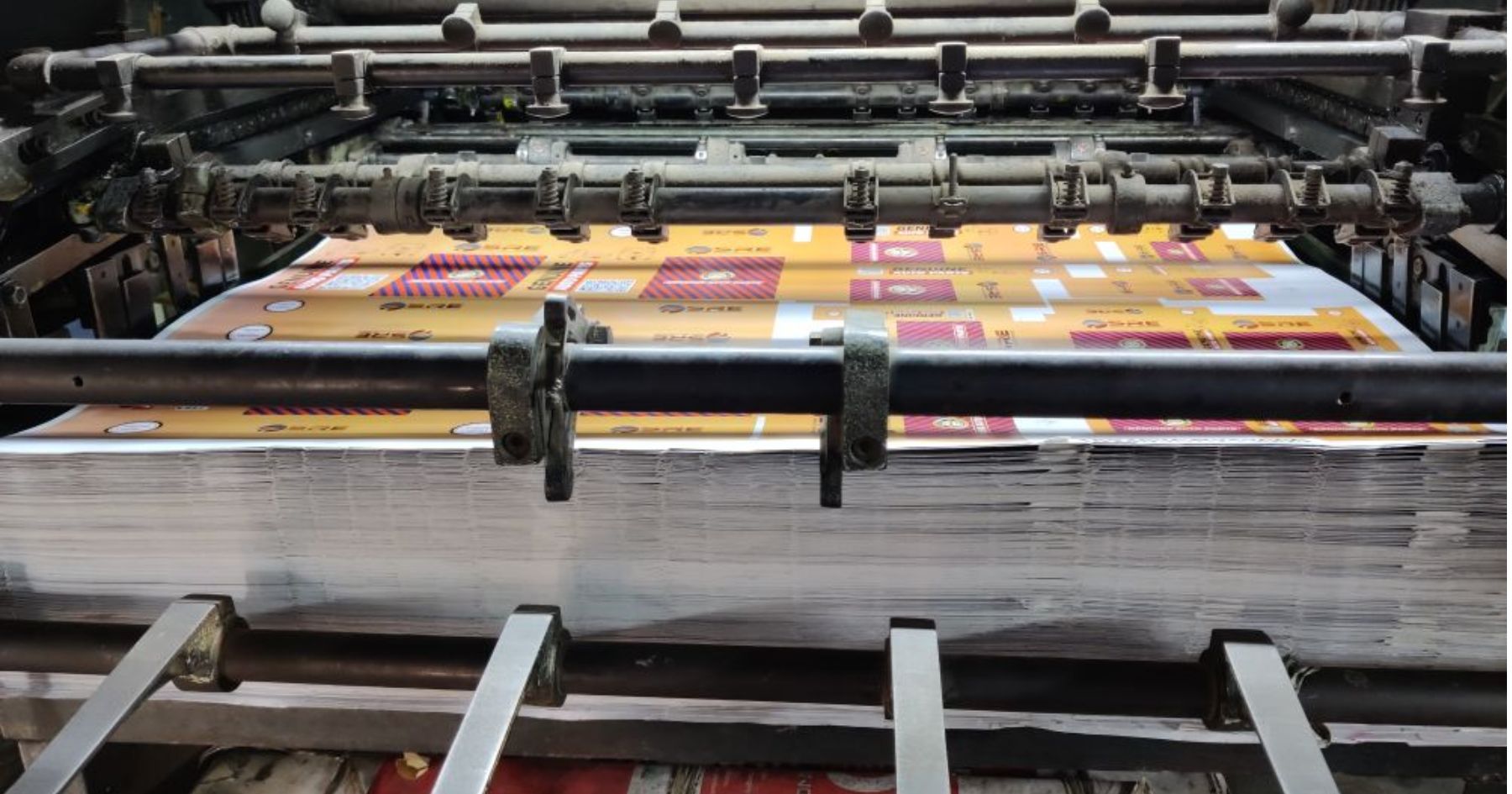
When a brand moves from sampling or small-run production into commercial-scale monocarton manufacturing, the conversation shifts from “can you print this” to “can you print this consistently, at volume, across substrates, and across every production run.”
This article is written for procurement managers and packaging development teams evaluating offset printing vendors for monocarton production — specifically at the point where brand volumes have scaled or are scaling and inconsistency, capability gaps, or vendor limitations have started to create problems.
Why Offset Printing Remains the Standard for Commercial Monocarton Production
Offset lithography has been the dominant printing process for commercial packaging for decades. At scale, it offers colour accuracy, consistency across long runs, and cost efficiency that digital and flexographic printing cannot match for monocarton volumes above a certain threshold.
For brands producing monocartons at 15,000 units per SKU and above, offset printing is typically the correct process. The setup cost — plates, make-ready, press calibration — is absorbed across the run, bringing unit costs down significantly compared to digital printing at the same volume. More importantly, offset delivers colour fidelity that is critical for brand packaging: a Pantone-matched brand colour needs to be identical on every box in a run of 50,000 units, and offset printing — when run on a well-maintained commercial press — achieves this consistently.
The question for a procurement team is not whether to use offset. It is which vendor’s offset capability is sufficient for the brand’s specific requirements.
What Brands Actually Evaluate When Selecting an Offset Printing Vendor for Monocartons
1. Number of Printing Colours in a Single Pass
Commercial offset presses are configured with a set number of printing units — each unit adds one colour. A 4-colour press prints CMYK in a single pass. A 5-colour press adds a fifth unit, typically used for a Pantone spot colour or a protective coating. A 6 or 7-colour press with an online UV coater prints full colour plus spot colours plus applies a coating — all in one pass through the press.
For brands with complex packaging artwork — multiple Pantone colours, metallic inks, brand-specific spot colours — a press with more units produces a more accurate result in fewer passes. Each additional pass through the press introduces registration variables and increases production time. A 7-colour press with an online UV coater eliminates the need for a separate coating pass entirely.
Globe Print n Pack operates a Komori Lithrone 7-colour press with UV coater. This means full colour print plus spot colours plus coating in a single pass — relevant for brands whose packaging artwork involves multiple colour layers and a surface finish applied online.
2. Substrate Range — Paper Only, or Plastic Too
Most commercial offset printers work with paper and paperboard. Printing on plastic substrates — PP (polypropylene) and PET (polyethylene terephthalate) — requires different ink formulations, press settings, and substrate handling. Not all offset facilities are set up for this.
For a cosmetics brand, a personal care company, or an FMCG manufacturer that uses both paper monocartons and transparent plastic boxes across its SKU range, this matters. Sourcing paper cartons from one vendor and plastic cartons from another adds complexity — two vendor relationships, two lead time tracks, two quality standards to manage, two sets of pre-press approvals.
A manufacturer that runs offset printing on both paper and plastic substrates on the same press allows a brand to consolidate its monocarton supply. The Komori Lithrone press at Globe Print n Pack prints on paper, paperboard, PP, and PET — which is not standard across most commercial printing facilities in India.
This capability was recognised at the NAEP 2024 Awards, where Globe received the award for Best PET Mono Carton — a direct recognition of print quality on transparent plastic substrate.
3. Finishing Capabilities — Online vs Offline
Print finishing — UV coating, matte lamination, gloss varnish, hot stamping, embossing — determines the final look and feel of the packaging. How that finishing is applied affects both quality and production efficiency.
Online finishing — where the coating is applied as part of the press pass — produces a more uniform result than offline finishing applied as a separate process after printing. It also reduces handling between processes, which matters for high-gloss or UV-sensitive finishes where scratches or contamination between stages affect the final surface.
The finishing options available at Globe Print n Pack for monocarton production include:
- Matte UV coating
- Gloss UV coating
- Spot UV (selective gloss on a matte surface — a finish commonly specified for premium cosmetics and FMCG packaging)
- Hot stamping in gold, silver, and holographic foils
- Embossing and debossing
- KDX lamination
- Window patching for paper cartons requiring partial product visibility
For brands specifying premium packaging — where the surface finish is part of the brand identity — the ability to achieve spot UV, hot stamping, and embossing from one facility matters. Splitting print and finishing across vendors introduces colour and surface quality variables that are difficult to control.
4. Pre-Press and Artwork Handling
At commercial scale, the pre-press stage — converting brand artwork into print-ready plates — is where most production errors originate. Colour profile mismatches, incorrect trapping, wrong bleed settings, and font issues that look fine on screen produce visible problems on press.
A vendor with an in-house pre-press team reviews artwork before plates are made, flags issues before they become production problems, and works with the brand’s design team or agency to resolve them. This is particularly relevant for OEM manufacturers who receive artwork from the brand they are producing for — the OEM needs a vendor who can manage artwork handoffs professionally and flag issues early rather than discovering them after plates are made or, worse, after a production run.
5. Quality Consistency Across Repeat Orders
For brands with ongoing monocarton requirements — multiple orders per year for the same SKU — colour consistency between production runs is a non-negotiable requirement. The first order sets the colour standard. Every subsequent order must match it.
Achieving this requires a vendor with documented colour standards, calibrated equipment, and a production process that records press settings from each run. ISO 9001:2015 certification is one indicator that a vendor has documented quality management processes — not a guarantee of quality, but evidence that the processes exist and are audited.
Globe Print n Pack is ISO 9001:2015 certified and has supplied repeat monocarton orders to FMCG brands including HUL, Godrej, and Wipro Consumer — brands whose internal packaging quality standards require consistency across every production run.
The Substrate Capability Gap Most Procurement Teams Discover Late
Here is a pattern that comes up repeatedly in packaging procurement.
A brand’s SKU range expands. What started as a paper monocarton range now includes transparent plastic packaging for certain products. The procurement team goes back to their existing paper carton vendor and discovers the vendor does not print on plastic. A second vendor is brought in for the plastic SKUs.
Now the procurement team is managing two separate vendor relationships, two lead times, two pre-press workflows, and two quality standards — for what is functionally the same category of packaging.
The brands that avoid this are the ones that qualify substrate range as a vendor selection criterion upfront — before the SKU range expands and before the problem is expensive to fix.
When evaluating an offset printing vendor for monocarton production, ask specifically: do you print on PP and PET, on the same press, with the same finishing options available as on paper? If the answer is no, factor the cost of a second vendor into your evaluation.
What Scaling Monocarton Production Actually Looks Like
Scaling monocarton production is not simply ordering more of the same box. It typically involves one or more of the following:
Adding SKUs with consistent colour across all of them. A brand that started with three SKUs now has fifteen. Every box needs to carry the same brand colours, the same finish quality, and the same structural specifications — across a range that may span paper and plastic substrates. This requires a vendor with the press capacity, substrate range, and pre-press capability to manage a multi-SKU programme.
Moving from a local job printer to a commercial manufacturer. Many brands start with a local printer for early-stage production runs. As volumes increase, the limitations of a smaller facility — colour inconsistency, slower turnaround, limited finishing options, no plastic capability — become problems. The move to a commercial offset manufacturer is typically triggered by a quality complaint, a missed deadline, or a retail partner’s packaging audit.
Adding export or modern trade requirements. Brands supplying to large-format retail or export markets face additional packaging requirements — SEDEX compliance, specific board grades, barcode placement standards, labelling requirements. A vendor with the certifications and documentation capability to meet these requirements reduces the compliance burden on the brand’s procurement team.
Globe Print n Pack is ISO 9001:2015 and SEDEX certified — relevant for brands whose retail or export partners require supply chain ethical compliance documentation.
Frequently Asked Questions — Offset Printing for Monocarton Production
What is the difference between offset printing and digital printing for packaging? Offset printing uses physical plates and is cost-efficient for commercial volumes — typically 15,000 units per SKU and above — with consistent colour reproduction across long runs. Digital printing has no plate cost and suits shorter runs or personalised packaging, but unit costs are higher at scale and colour consistency across very large runs is harder to guarantee than with offset.
Can offset printing be done on plastic packaging — PP and PET boxes? Yes, but not at every facility. Printing on PP and PET requires specific ink formulations and press configurations. Globe Print n Pack prints on PP and PET substrates on the same Komori Lithrone press used for paper and paperboard — making it possible to produce both paper monocartons and transparent plastic boxes from one manufacturer.
What is a 7-colour offset press and why does it matter for packaging? A 7-colour press has seven printing units, allowing it to print full CMYK colour plus additional Pantone spot colours plus an online coating in a single pass. This matters for brands with complex packaging artwork involving multiple brand colours and a specific surface finish — achieving this in one pass produces more consistent results and reduces production time compared to multi-pass printing.
What finishing options are available with offset printed monocartons? Standard finishing options include matte UV, gloss UV, spot UV, hot stamping (gold, silver, holographic), embossing, debossing, and lamination. Window patching is available for paper monocartons that require partial product visibility. The specific combination available depends on the manufacturer’s in-house capability — confirm at the brief stage.
What MOQ applies to offset printed monocartons at Globe Print n Pack? Standard MOQ is 15,000 units per SKU. This applies across substrates — paper, PP, and PET. The plate and make-ready costs of offset printing are distributed across the run, so unit economics at 15,000 and above are significantly more favourable than at lower volumes.
How do I ensure colour consistency across repeat orders? Confirm with your vendor that press settings and colour profiles are documented from the first production run and retained for repeat orders. ISO 9001:2015 certification is an indicator that documented quality management processes are in place. For brand-critical colours, request a Pantone-referenced colour standard be set at first production and matched on all subsequent runs.
Working With Globe Print n Pack for Offset Monocarton Production
Globe Print n Pack is a commercial offset printing and packaging manufacturer based in Vasai, Mumbai. We operate a Komori Lithrone 7-colour press with UV coater, printing on paper, paperboard, PP, and PET substrates — with full in-house finishing including spot UV, hot stamping, embossing, and window patching.
We supply to procurement teams at established brands and to OEM manufacturers sourcing printed monocartons on behalf of brands. Standard MOQ is 15,000 units per SKU. We are ISO 9001:2015 and SEDEX certified.
If you are evaluating offset printing vendors for monocarton production — for a new SKU, a range expansion, or a vendor consolidation — share your brief with our team.
Request a quote → View our cosmetic packaging → Explore our technology → View our PET packaging
Globe Print n Pack Industries Pvt. Ltd. | Vasai, Mumbai | ISO 9001:2015 | SEDEX Certified | NAEP 2024 Award — Best PET Mono Carton